|

Benjamin Zuckerman, professor of physics and astronomy at UCLA, Gregory Henry, a Tennessee State University astronomer, and Michael Muno, an astronomer at Caltech at the time, were studying BD+20 307, a main sequence star (a star at its nuclear fusion of hydrogen into helium stage). This star, located in the Aries constellation about 300 light-years from Earth, is surrounded by no less than one million times the amount of dust than that surrounding our sun, making it the dustiest main sequence star known. They were trying to measure the age of this star using data from the Chandra X-ray Observatory and from one of Tennessee State University‘s automated telescopes in southern Arizona.
“We expected to find that BD+20 307 was relatively young, a few hundred million years old at most, with the massive dust ring signaling the final stages in the formation of the star’s planetary system,” Muno said. However, they were in for a surprise. Carnegie Institution of Washington astronomer Alycia Weinberger announced in the May 20, 2008 issue of the Astrophysical Journal that BD+20 307 is actually a close binary star , a system of two stars orbiting the system’s center of mass.
Tennessee State University astronomers Francis Fekel and Michael Williamson were asked to provide additional spectroscopic data from another telescope in Arizona to assist in understanding the binary star. “That discovery [that the star is in fact two stars] radically revised the interpretation of the data and transformed the star into a unique and intriguing system,” said Fekel.
The newly provided data confirmed that BD+20 307 is in fact a binary star with two stars of mass, temperature, and size not unlike our sun’s. They have an orbit period around their center of mass of 3.42 days. The age of the system still had to be determined, but standard age determination methods were no longer applicable to the system. The team studied the element abundances in the system, and found it to be low on metal. This, along with the measured level of lithium, indicated an age of several to many billion years, much older than a few hundred million years, the originally predicted age of the supposedly single star.
|

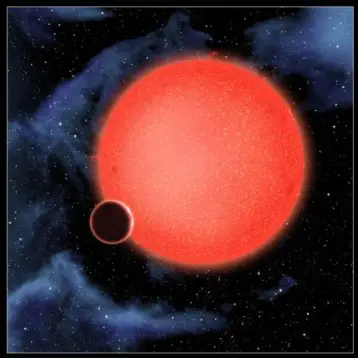
The dust surrounding the binary star is evidence of a collision between two planets that took place quite recently. The dust is orbiting the binary star very closely, where terrestrial planets are most likely to be. Usually small dust particles get pushed away by stellar radiation, while the larger pieces are reduced to dust in collisions within the disk and then meet the fate of small particles. Therefore the presence of such large quantities of dust near the binary star suggests the dust forming collision near BD+20 307 took place probably within the past few hundred thousand years, if not more recently.
This collision is quite unique, as it is the first known case of a major collision taking place in a mature planetary system. “This poses two very interesting questions,” Fekel said. “How do planetary orbits become destabilized in such an old, mature system, and could such a collision happen in our own solar system?”
The stability of planetary orbits in the solar system has been considered over the last two decades by a number of astronomers. “Their computer models predict planetary motions into the distant future and they find a small probability for collisions of Mercury with Earth or Venus sometime in the next billion years or more. The small probability of this happening may be related to the rarity of very dusty planetary systems like BD+20 307”, Henry said.
It seems that as far as planetary collisions are concerned, we are safe for now.
TFOT has previously reported on NASA’s discovery of a planetary system with four suns, arranged in two sets of binary stars, and on NASA’s detection of a strange dusty ring surrounding the remains of a star.
Further information on the new research, scheduled for publication in a December issue of the Astrophysical Journal, can be found in the arxiv website and in the UCLA press release.